
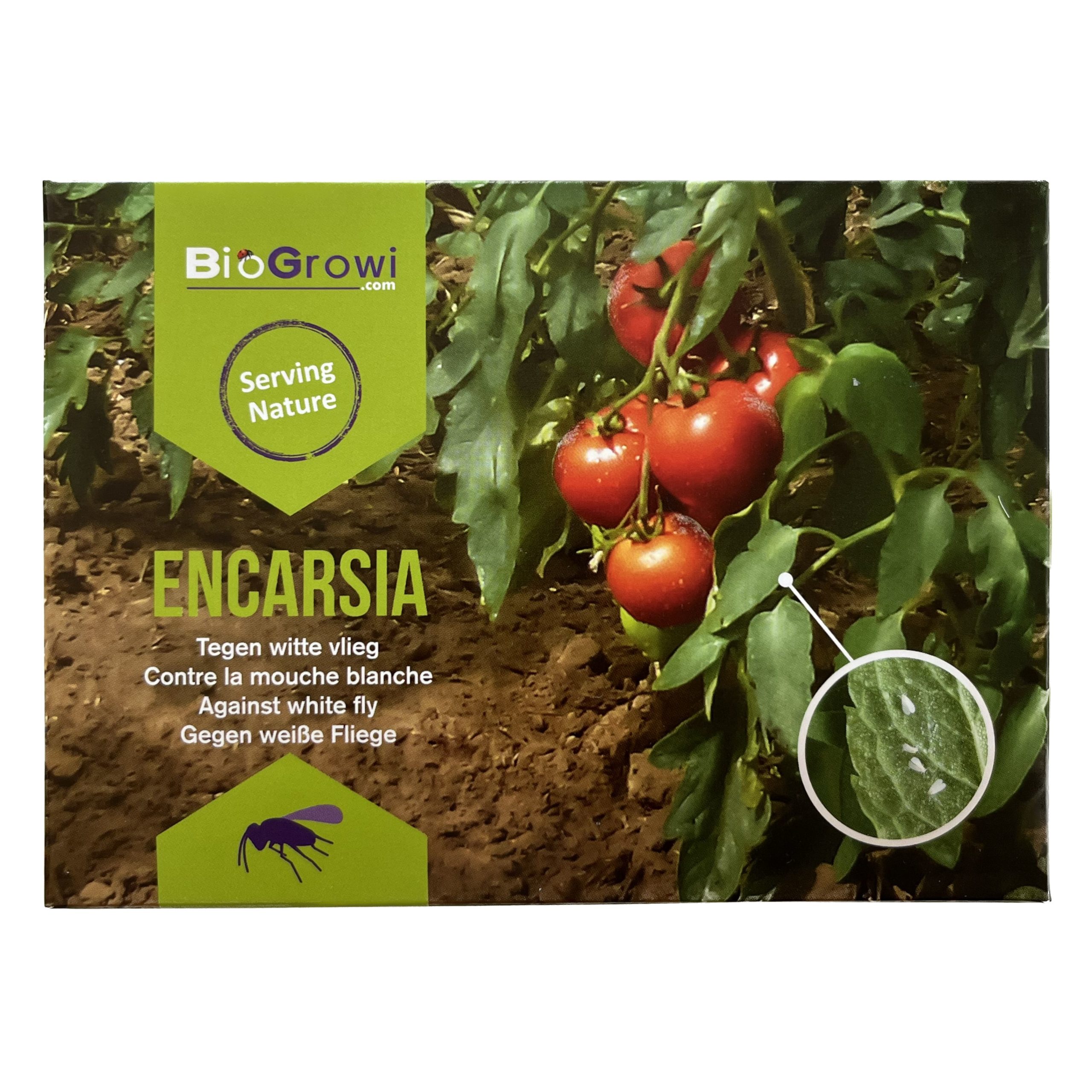

Encarsia formosa contre la mouche blanche
Encarsia formosa est une guêpe parasitoïde utilisée pour combattre rapidement et de manière biologique la mouche blanche sur les légumes et les plantes ornementales en serre.
La mouche blanche également appelé aleurode est un petit ravageur volant de couleur blanche terne, assez commun en serre qui menace un grand nombre de cultures.
Les étapes du parasitage de la mouche blanche par l’Encarsia formosa :
- La femelle Encarsia pond un oeuf dans la larve de mouche blanche
- Pendant quelques jours, la larve qui est sortie de l’oeuf se développe à l’intérieur de la larve de mouche blanche
- La larve de mouche blanche parasitée devient noire
- Encarsia, une fois son développement terminé, sort de la larve de mouche blanche morte en formant un trou
Durant son existence, un Encarsia parasite en moyenne 250 larves de mouches blanches (450 au maximum) et peut en tuer 30 à 70 pour son alimentation.
Pour la détection et le piégeage des mouches blanches adultes, il est conseillé d’utiliser le piège adhésif jaune.
Utilisation d’Encarsia formosa
Le produit se compose de petits cartons sur lesquels sont collées des pupes de mouches blanches parasitées par les petites guêpes Encarsia formosa. Il y a 100 pupes par carton. Il faut suspendre un carton par 3 m2 à une distance de 50 cm sous le sommet des plantes. Quelques jours après, les petites guêpes parasitoïdes sortent des pupes, se dispersent dans la serre et commencent immédiatement à parasiter les larves de mouches blanches.
Pour pouvoir se développer, Encarsia formosa nécessite une température minimale de 18°C durant la journée et de 6°C la nuit. À plus de 30°C, elle est moins efficace. Il est conseillé d’ombrager la serre durant l’été. Il est possible d’ouvrir les fenêtres de la serre car les Encarsia formosa sont trop petites pour parcourir de longues distances.
Il est vivement conseillé d’introduire dès l’observation des premières mouches blanches et avant les fortes infestations.
Ne pas utiliser de produits chimiques avant et après l’introduction.
Les quantités d’Encarsia formosa :
- 1000 Encarsia pour une surface de 30 m²
- 5000 Encarsia pour une surface de 150 m²
Conservation
Afin d’éviter une perte de qualité, il est nécessaire d’introduire Encarsia formosa rapidement. Toutefois, si nécessaire, il est possible de conserver les cartons avec les pupes d’Encarsia formosa pendant 1 à 2 jours à une température de 8°C.
La période de traitement
Janv – Févr – Mars – Avr – Mai – Juin – Juill – Août – Sept – Oct – Nov – Déc
Les principales cultures touchées
Cultures sous serre : Tomate – Concombre – Aubergine – Poivron – Fraisier – Plantes d’intérieur
Pour consulter le mode d’emploi en PDF, cliquez ici.
Paiement sécurisé
Visa – Mastercard – Bancontact – PayPal
Consultez nos frais et délais de livraison ici.